ADNOC: 100% Generative Production.
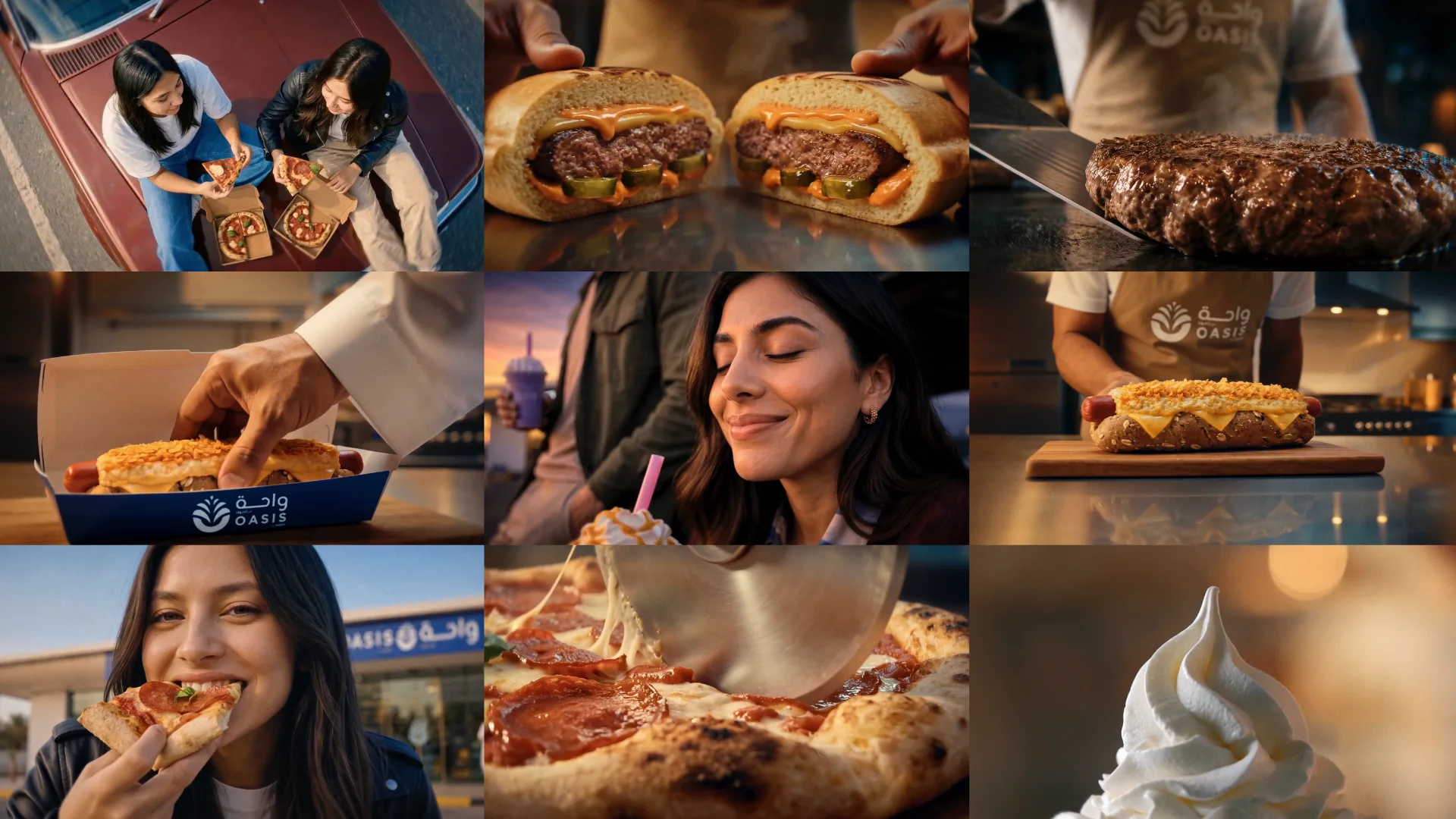
ADNOC’s food service menu was expanding with four new products at once: a no-mess burger, a hot dog built around Oman-style chips and Falcon sauce, a Neapolitan-style pepperoni pizza, and a cheesecake shake. Optix, the Publicis Groupe Dubai production house leading the launch, partnered with MAIZE to create the campaign: four 20-second hero films together with a full suite of digital reformats, produced entirely through generative production.
There was no camera on set. No physical kitchen. No product placed in front of a lens.
Yet the production remained fundamentally about food. Whether an image is captured through a lens or generated from a prompt, the same craft still applies: understanding how light shapes a burger bun, how cheese stretches under heat, or what makes a hot dog feel fresh off the grill. The production method changed. The standard for food imagery did not.
The challenge
From a production perspective, the project demanded four distinct product stories while maintaining one cohesive visual language across every film and every reformat. Everything had to be generated digitally, with no shoot days, no food styling on set, and no physical locations. Products, characters, and environments needed to remain perfectly consistent throughout the campaign despite being created entirely within a generative workflow.
The timeline added another layer of complexity. The first two films had to move from brief to delivery-ready assets in just two weeks - a schedule that would have been difficult to achieve through a traditional production pipeline.
Authenticity was equally important. Two of the featured products carried strong cultural references. The pizza drew directly from Neapolitan tradition, while Falcon sauce has been part of the UAE’s food culture for more than fifty years and remains a nostalgic product for many consumers. The visuals therefore had to respect not only the products themselves, but also the expectations and associations audiences already had with them.
The approach
Generative production succeeds or fails on consistency. Without carefully designed workflows, products drift between shots, characters subtly change, and environments lose continuity. To solve this, MAIZE relied on a its own production pipeline refined over more than two years of commercial work, giving the team precise control over products, characters, lighting, and locations throughout every stage of production. The result was a seamless visual language across all four films and every derivative format.
Technology alone, however, was only part of the solution.
The project was approached from a food-production perspective rather than an AI-first one. Decisions about crust texture, condensation on the shake, the way melted cheese behaved, or how light interacted with the burger were guided by the same food know-how that define traditional food photography and film. Those principles were simply translated into a fully generative workflow. The pipeline was the delivery mechanism. The food expertise behind every project is the essence of our "food first" approach. Generative production became another way of applying it.
“Working with AI doesn't change the essence of directing: you still set the creative vision, make every decision, and communicate it to the team. Everything I'd learned on traditional sets proved useful, because the visual decisions are the same - except in a generative workflow many of them have to be made precisely upfront, whereas on a shoot you can often decide once you see the image in the camera. The rhythm is different too: instead of everything peaking during shoot days, your engagement stays constant across the whole project. And it was only this full-AI approach that let us deliver what the client expected in such a short time. Though I'll admit - I sometimes missed the buzz and tangibility of a real set.”
— Jakub Hajduk, director
The outcome
The campaign delivered four hero films alongside a complete set of 9:16 and 4:5 reformats for the UAE market - produced entirely through a digital workflow, without a single physical shoot day.
The project demonstrated that a success of a generative production depends heavily on the food expertise. The same understanding of light, composition, texture, and appetite appeal that defines high-end food production proved just as essential inside a fully generative pipeline.
What this project demonstrates
End-to-end generative food production with no physical shoot.
A proprietary production pipeline delivering consistent products, characters, and environments across multiple films and reformats.
Food-specialist creative direction translated into a fully generative workflow.
Creative development and production delivered within an international campaign timeline, with the first films completed in just two weeks.
Project summary
- Scope
- Generative food production for Optix (Publicis Groupe Dubai) supporting ADNOC’s QSR product launch. Four 20-second hero films featuring a no-mess burger, a Falcon sauce hot dog, a Neapolitan-style pepperoni pizza, and a cheesecake shake.
- Production
- Thirty days of generative production, online, and colour finishing. Zero physical shoot days.
- Market
- UAE, digital campaign.
- Credits
- Client: ADNOC Production House: Optix (Publicis Groupe Dubai) Generative Food Production Studio: MAIZE